
Everyone is getting yaoipilled
Also: dead apps, furries and Neopets

Welcome back to Scrolling Through It! First of all, apologies for this post being delayed. I’ve had some equipment difficulties this week.
We have hit the final edition of 2025; I think it’s fair to say that we will all be trying to be more offline in the coming weeks as the holidays come around, and that includes me. Please enjoy this year’s final dip into the depths of media happenings.
Fujoing out about hockey
Last week the queer outlet Them released a pretty neat piece about the rise of “fujoing out” and what it all means. To summarise: fujoshi is a term from Japanese animanga fandom and means a female fan of the boys’ love (and/or yaoi) genre. So essentially a woman or girl who likes media content about gay male relationships. Now, why is this all super relevant right now and why is this a key term to know?

There’s this big new HBO/Crave show out at the moment. You may have heard of it. It’s called Heated Rivalry. It’s about hockey. It’s based on the bestselling erotic series Game Changers by Rachel Reid. And it has “escaped containment” and become a kind of mainstream hit. Like many Booktok hits before it, it has roots in fanfiction as well, originally being written as Stucky (Steve Rogers and Bucky Barnes) fanfic. When we consider the popularity of M/M fanfiction, it was perhaps the next natural step for gay pairings to find their way into mainstream much like prior heterosexual hits.
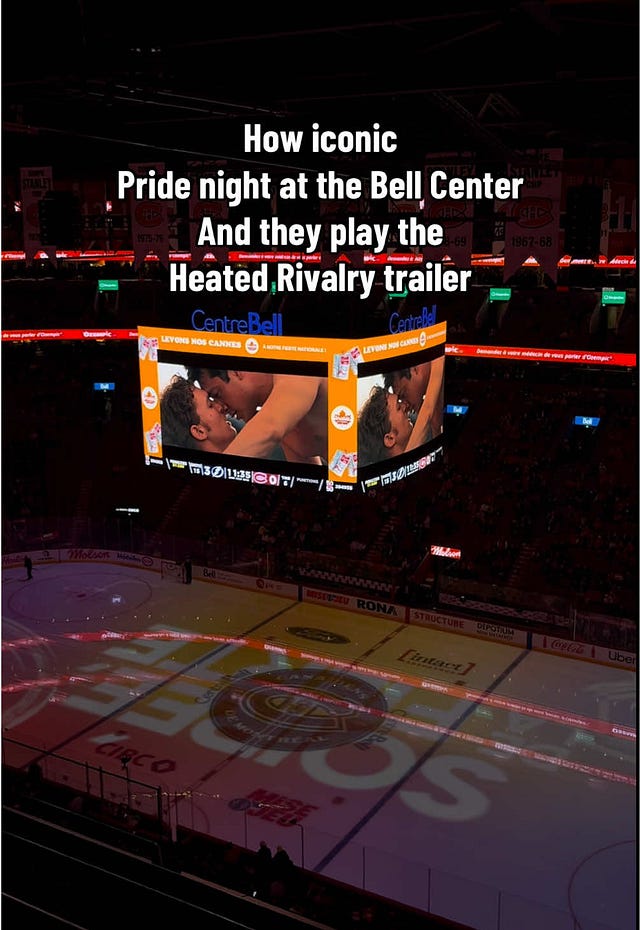
 Tiktok failed to load.
Enable 3rd party cookies or use another browser
Why are female audiences in particular so into M/M gay romances? What is the appeal of “fujoing out” about? No one has really been able to answer this exactly, although it has been a topic of discussion for decades, and that same discussion has obviously been reignited in the present. Some appeal is accounted to the removal of the male gaze and patriarchal norms that female characters are created within, allowing female readers to separate themselves from the scenarios and to enjoy them more. Some just like attractive men and these pairings, of course, whereas others the opportunity to explore a different perspective. Romance in general - regardless of the gender of the pairing depicted - tends to be a genre enjoyed by female audiences more than male audiences too. I highly recommend this translation of a 1991 article by the Japanese author Yonezawa Yoshihiro in which the appeal of boys’ love is dissected.
Of course, the appeal of these stories is not limited to cis, hetero female audiences either, although mainstream attention has largely been focused on the question of “why are straight women so into this”. Many women consuming these queer stories are also queer themselves, as are the women creating them. Likewise, boys’ love is a genre enjoyed by queer audiences more broadly regardless of gender of sexuality, offering an avenue for exploration and reflection on screen or on the page.
Back to why all this is relevant right now. Heated Rivalry is the biggest sign that studios are noticing the potential in fujoing out, but not the only one. Netflix has a film adaptation of a yaoi manga coming out in a matter of days: 10DANCE is currently being promoted with giant posters and videos at Shibuya Crossing. The gay drama Boots was a hit with critics and fans (although it did just get cancelled, in true Netflix style). Amazon is currently developing the sequel to the hit Red, White and Royal Blue. China’s censorship unfortunately regularly stalls the production and accurate adaptation of danmei works, but The Untamed and Heaven’s Official Blessing have attracted many fans in recent years despite challenges. And in South Korea, an 18+ webtoon platform called Lezhin is now taking characters from its most popular BL titles and turning them into an animated K-pop group.
Is the rise of M/M romance in media a positive sign of more open attitudes towards queer relationships? Or is it a problematic trend that only exists for profit? And is there a fetishisation problem? There is no straightforward answer to any of these questions, but it can be safely said that this media trend isn’t exactly lining up with social progress globally.
The support for queer people doesn’t always translate from these romance fantasies to real life, neither when it comes to brand values nor individual views. NYT Cooking was happy to benefit from the virality of the tuna melt (key dish from the show), but NYT itself has become known for anti-queer, particularly anti-trans, rhetoric. The NHL might be lapping up the new fans, but it is known for its insular nature, and has previously banned all pride symbols among players including rainbow tape and practice jerseys.
The other issue is around the depiction itself. Some note that boys’ love works can be reductive and stereotypical in how the dynamics and characters are written, as indeed many stories are written by women. Additionally, female characters and F/F relationships don’t get the same type of support in media, with fewer works about women’s romance written and produced. As a result, we’re not getting yuripilled just yet. But maybe that will be next, alongside hopefully better all-round representation which isn’t just limited to trends.
A digital nostalgia double whammy
I’m a little late to the party on this one, as this collaboration has been around for a month now, but I only came across it last week. Millennial favourite Neopets has partnered with another Millennial favourite Habbo Hotel. The partnership includes Neopets cosmetics inspired by the pixelated style of Habbo, Neopets-themed items for Habbo Hotel, and mini games on the Habbo website. There’s also been multiple “drops”, with the most recent one being a Christmas one, of course.

Both websites have struggled over the years as their user bases have aged out and/or shifted towards social media. The death of flash also caused issues, in particular for Neopets which had many problems with functionality and had delays in converting popular features. However, Neopets has seen a resurgence in player growth in the past year; likewise Habbo saw a resurgence during Covid lockdown and currently sees numbers that don’t indicate its death just yet. It is probably safe to say that each site’s playerbase is made up of many older players who have either stuck around for decade(s) or returned for a relaxing nostalgia kick (in the case of Neopets - some are introducing their kids to it). The companies know this and are leaning heavily into nostalgia in their respective strategies, from Neopets reviving their trading card game to Habbo offering the “lovingly restored” 2005 game experience as a separate mode. This collaboration between the two sites - which have some overlapping target audience, for sure - is a clever extension of this.
An update on words of the year
A few weeks ago I wrote about words of the year that had been announced up until that point. Some more “winning” words have now been announced. Oxford Dictionary announced theirs as “rage bait”. Very appropriate for how we engage with each other online, including how politicians behave now. What’s real and what’s a lie or exaggeration just to get a rise out of someone? Who knows. As long as it provokes, gets clicks, gets engagement, and creates further division in an already fragmented world. The other shortlisted words (phrases) were “aura farming” and “biohack” which further highlight the focus on appearances and how we intentionally present ourselves in a digital and tech focused world.
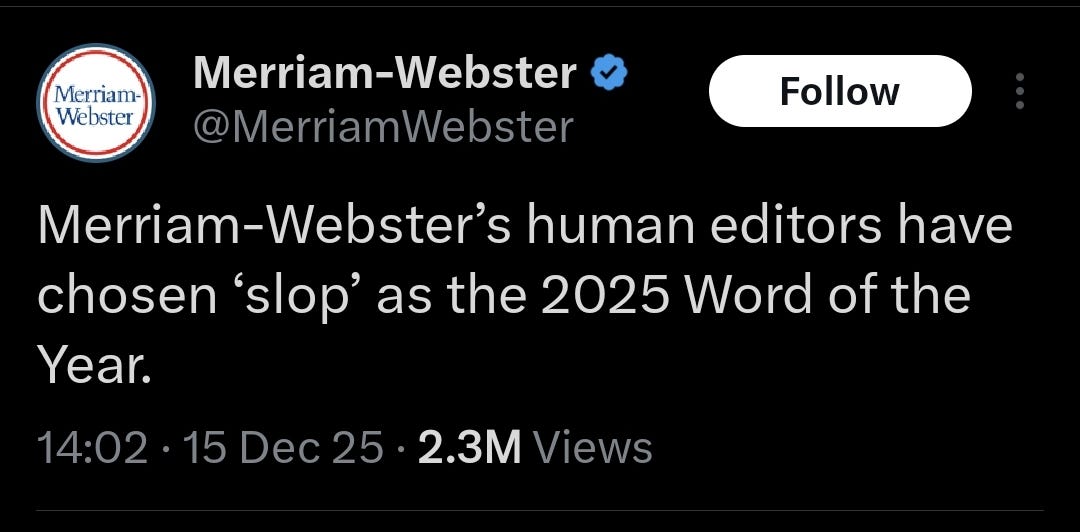
On a similar note of having to work out what is real, Merriam-Webster chose “slop”. A great, illustrative, evocative word to sum up the AI age we are currently in. We are drowning in AI content pushed by tech giants, politicians, brands and social platforms; it is endless, it lacks quality, humanity, individuality or uniqueness - so, slop. My personal highlight from Merriam-Webster? “Touch grass”. We should do more of that.
A fandom app has suddenly died
The platform Amino suddenly and unexpectedly shut down this past weekend, leaving users confused. Especially as the company has not actually released a statement - the app and site just disappeared. Some people have celebrated this, others are mourning the downfall of the platform. But for many, this felt like a long time coming unfortunately.
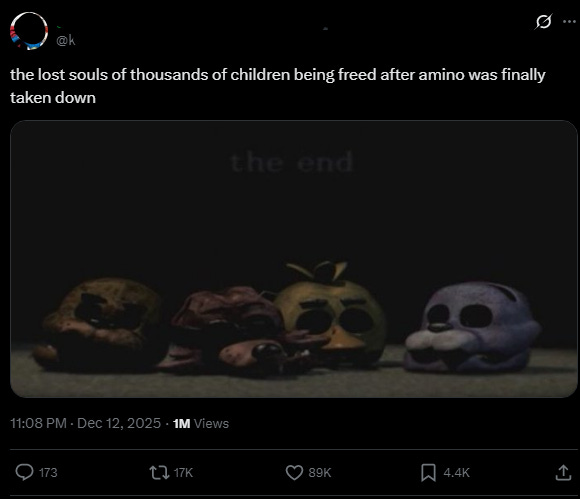
The fan platform had a bit of a shaky history. Developed as a website 2010, it officially launched as an app in 2012 and continued to develop as an app-first experience. Inspired by anime conventions, the intent behind the platform was to create a convention-like community in the digital space, facilitating the sharing of cosplays, roleplays, fanart and other creative aspects of fandom. The platform saw massive growth at the end of the decade; by 2018 the platform hosted over 2.5 million fan communities and secured further $45 million in VC funding on top of previous funding rounds. Still, its owners could not keep up with the user demand and platform growth.
As a result, in 2021 the site was sold to MediaLabs (the company which also owns Kik and Imgur among others, and acquired Whisper before that also shut down). However MediaLabs had no clear strategy for the platform and contributed minimal investment, which translated into (continued) poor user experience on the site: glitches, service limitations, inability to opt out of ads even with a paid subscription, staff shortages and ultimately dwindling user interest. More importantly though, over time the platform became infamous for toxic behaviour within user-moderated communities and instances of grooming among its numerous underage userbase.
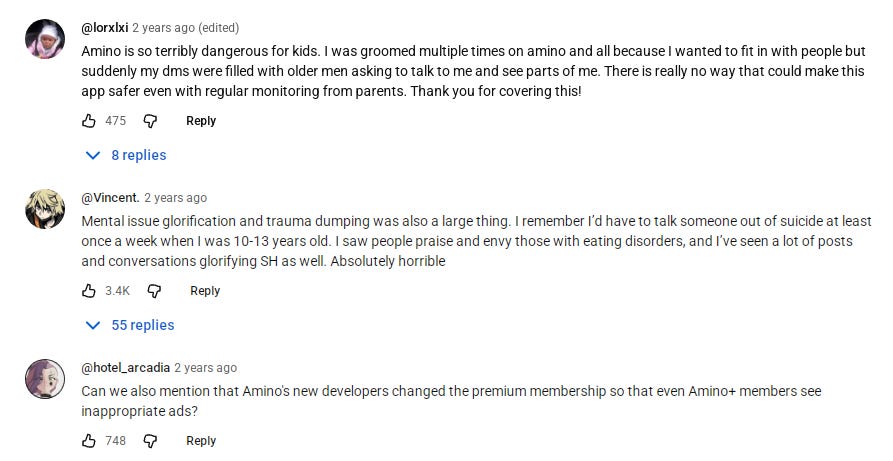
Discussions about Amino’s issues are not new; the app shutting down has only freshly brought them to the surface. Amino is not alone in being scrutinised for lax moderation and safeguarding of young users either; platforms like Discord and Roblox have earned similar reputations among users and critics in recent years as providing easy pickings for predators (notably Discord is one of the platforms where many old Amino users migrated to). Undoubtedly Amino provided an interesting community-building model, even down to the opportunity for the community to self-moderate to an extent, but it also laid bare the issues many social platforms share: failure to protect users from bad agents, no matter what age.
It will be interesting to see if and when we may eventually get a statement from MediaLabs about Amino’s closure. Analyses and think pieces will likely follow; I assume the lack of coverage for now is due to the uncertainty around the situation, not just the relatively niche nature of the app in the present day. According to some community members this may just be an outage. It is a very odd one, if so.
Everyone loves this cartoon wolf
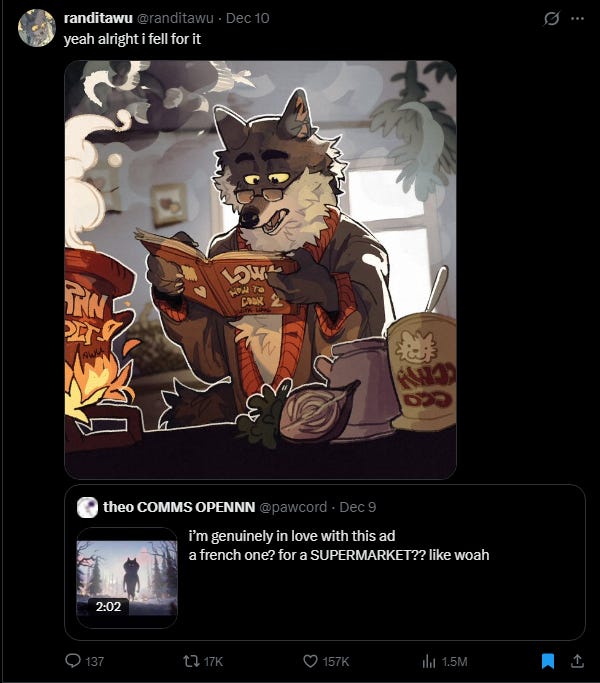
It feels like we have been faced with a barrage of AI-generated ads this year, and it seeped into he holiday season. I wrote about the Coca-Cola backlash before, and since then McDonald’s released and then pulled an AI ad of their own. Conversely, companies making adverts with heart and human craft have been breaking through. The one that’s been particularly interesting to me is the animated ad for the French supermarket chain Intermarché, featuring a wolf who gives up eating meat. People responded to the ad with great enthusiasm, thanks to the human-made art, the narrative, and the protagonist himself - a wolf called Albert, who essentially has his own fandom now. Sometimes all it takes for an ad to break through is a lot of heart and getting the furry community on your side (and I’m not even kidding here, they are a vital part of the internet ecosystem in many ways!)
Not done scrolling yet? Check these out.
GameStop Hires TikToker Who Went Viral for Best Buy Ads (the online response to this has been uncomfortably horny)
Why is ‘Harry Potter’ so big in Japan? ‘Oshikatsu’ fandom. (cool piece on fandom, but also does need to be said that JKR’s political views don’t tend to be well known outside the anglophone west)
The Rise And Fall of Queer Cartoons (excellent piece!)
Kids Rarely Read Whole Books Anymore. Even in English Class. (depressing!)
UK Lawmakers Propose Mandatory On-Device Surveillance and VPN Age Verification (very worrying!)
Thank you for reading over the past few months. Happy Holidays, Merry Christmas, and see you in 2026!